
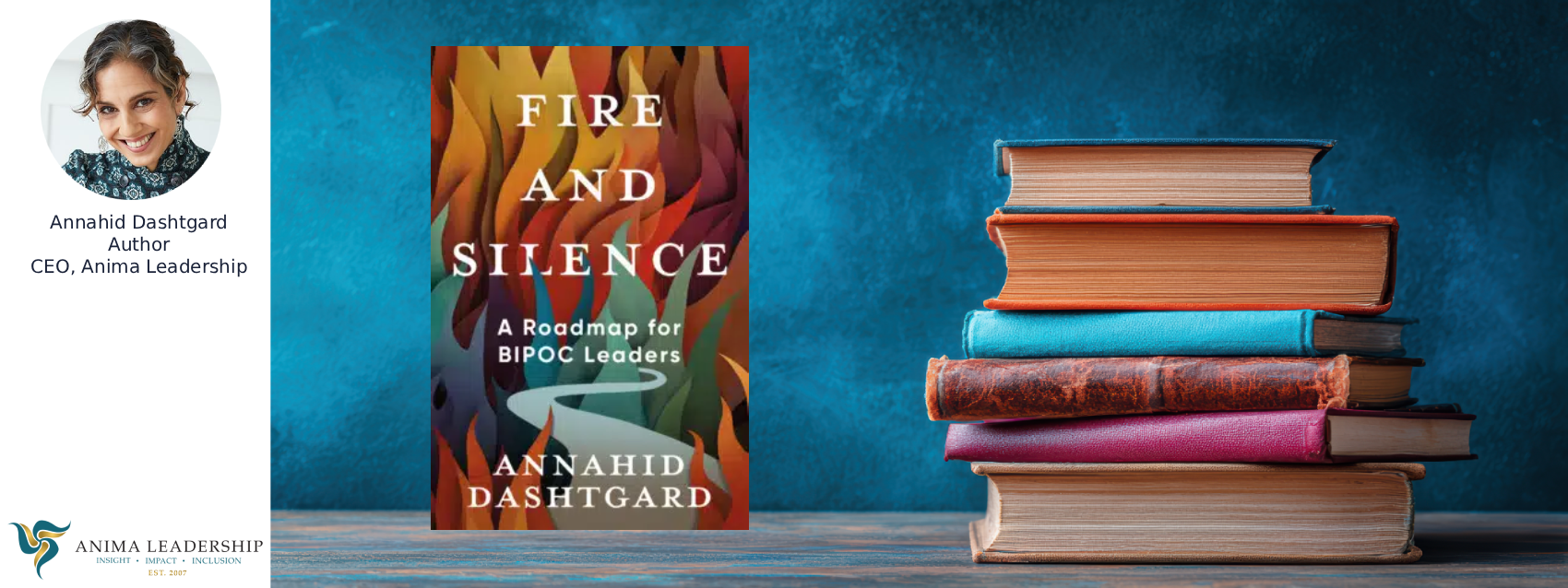
Date: April 17, 1-2 PM ET
Cost: Free (Zoom Webinar)
*Please note, all registrants will be provided with a link to the recording and presentation slides following the sessions. The recording will be available for 60 days.

In these politically fraught times, organizations need diverse leaders to help navigate uncertainty and complexity. Based on Dashtgard's third book, Fire and Silence: A Roadmap for BIPOC Leaders, this conversation focuses on the patterns holding back leaders of various minoritized backgrounds and what steps can be taken to create psychologically safe environments where people of all backgrounds and identities can thrive... and contribute to the systems change necessary. Leaders of every identity are invited to this open-hearted conversation about equity next steps in the environmental sector.
Annahid will be in conversation with Anna-Liza Badaloo who is a Vision2030 Justice, Equity, Diversity & Inclusion Program Associate at Sustainability Network.


The Author

Annahid is CEO and co-founder of Anima Leadership, a global-reaching socially innovative company that has been revolutionizing JEDI (justice, equity, diversity and inclusion) work in organizations and communities since 2006. Over the last twenty-five years Annahid has inspired, educated and coached thousands of individuals and hundreds of organizations toward deeper experiences of belonging.
With a Masters in Education and undergraduate degree in psychology, as well as additional certifications in Process Work conflict facilitation, Somatic experiencing trauma training, and Traditional Chinese Medicine, she brings a deeply inside-outside approach to cultivating systemic shifts. She started out as a political activist organizing national campaigns but now focuses on change one conversation, one compelling story at a time.
The DEFNP workshop series will offer tailored programming designed to match ENGOs on their decolonial (un)learning journeys. In Spring 2026 members of the ENGO sector will be able to choose one of three workshop tracks: Introduction to Decolonization in the ENGO Sector, Advanced Decolonial Theory and Application or For Indigenous Ears Only - A Space for Reflection and Action. Each series consists of four three-hour sessions.
Collectively, Decolonizing ENGO-First Nation Partnerships fosters:
Awareness of settler colonialism and the ways it potentially harnesses civil society;
Understanding about how Canadian law such as the Indian Act and the Income Tax Act has suppressed Indigenous governance systems;
Awareness that Indigenous peoples have unique inherent political and legal systems, with which ENGOs may want to form partnerships;
A better understanding about how to navigate partnerships with Indigenous communities that promote decolonial environmentalism;
A stronger sense about how to identify and explain individual and organization social locations (i.e. positionalities) as part of ethical partnership development;
Promoting the resurgence of Indigenous self-determination in the Canadian ENGO sector.
Cost: $100 (Register 2 spots, get the 3rd free)
70 participants max.
All registrants will be provided with a link to access the recordings and presentation slides for 60 days following each session.
Session 1: Settler Colonialism 101
Introduce ENGO representatives to the fact that colonization is a structure and not an event. Identifies key ways that colonialism moves through individuals and organizations.
Session 2: Positionality
ENGO representatives learn how to articulate their social location within a settler colonial state, and in relation to potential Indigenous partners.
Session 3: Inherent Indigenous Governance 101
Introduce the fact that Indigenous nations have their own sources of political authority that they can (and do) draw on when addressing environmental issues. Examples provided.
Session 4: Building Better Relations
ENGO representatives will road test ways they can implement previous workshop key points to re-imagine partnerships with Indigenous nations.
Cost: $100 (Register 2 spots, get the 3rd free)
All registrants will be provided with a link to access the recordings and presentation slides for 60 days following each session.
Session 1: Diagnosing Settler Colonialism in the Enviro Sector
Participants will be asked to share ways in which they have diagnosed and traced power in social justice movements and/or in the ENGO sector. This workshop will make space for discomfort as part of promoting decolonization.
Session 2: Inherent Indigenous Governance
A mix of advanced and introductory theory, this workshop delves into legal and political pluralism, naming the fact that Indigenous nations have their own sources of political authority that they can (and do) draw on when addressing environmental issues.
Session 3: The Nonprofit Industrial Complex
ENGO participants are introduced to theories and examples describing the Nonprofit Industrial Complex and the “Shadow State.” Purpose is to show how settler colonialism structures civil society.
Session 4: Decolonizing ENGO-First Nation Partnerships
This workshop delves deep into how ENGOs can partner with Indigenous nations beyond the Nonprofit Industrial Complex while promoting deference to inherent Indigenous political leaders.

Cost: Free
The Indigenous only space will be collaborative in nature but critical in approach. This track is a space for Indigenous folks within the ENGO sector to come together to discuss their experiences and work, with an eye to taking a position on what the sector might need to do in order to promote decolonization. Participants will use the first session to define our goals for the remaining three meetings. Therefore, session topics named here are proposals only.
Session 1: Naming the Cannibal: Settler Colonialism in the ENGO Sector
Session 2: Proposed topic: Reflections on working in the ENGO Sector
Session 3: Proposed topic: Centering Indigenous Thought in the ENGO Sector
Session 4: Proposed topic: Visioning a Decolonial Environmental Sector
.png)
© 2025 Sustainability Network


